Many Kudumi families, and many writers of the community, say that their people are mentioned in the Itihas (the Ramayana and the Mahabharata) and in the Puranas. The claims usually take three forms: that the community takes its name from Kurma, the tortoise incarnation of Vishnu; that it descends from the sons of Rama, Kusha and Lava; and that it belongs to an old Kshatriya line. This article reads these claims against the texts and the scholarship. It finds that no epic or Purana, as far as the sources reviewed show, names the Kudumi of Chotanagpur or of Odisha. The Kurma story, the Kusha and Lava story and the Kshatriya genealogies are real and old, but their link with the Kudumi is a later community tradition, most active in the twentieth century. This does not make the tradition worthless. It is a record of how a community saw itself, and it should be kept as such. The article also adds the Odisha view, where Kudumis use the titles Mahanta (Kendujhar and Sundargarh) and Mohanta (Mayurbhanj), and where the epic and Puranic geography is that of Utkala, Kalinga and the Vaitarani.
Keywords: Kudumi, Kurmi, Itihas, Puranas, Kurma, Kusha and Lava, Kshatriya claims, Odisha, Mahanta, Mohanta.
1. Introduction
Every community wants to know where it stands in the old stories of India, and the Kudumi are no different. In Kendujhar, Mayurbhanj and Sundargarh, in Purulia and Ranchi, an elder may say with pride that his people are mentioned in the Puranas, that the name Kurmi comes from Lord Kurma, or that the community came down from the family of Rama. These sentences are said in homes, in meetings and in small community books, and they matter, because they give people a sense of dignity and of belonging to the long story of Bharat. A research article cannot simply repeat them, however, and it cannot simply dismiss them either. It has to ask what the texts actually say, how the claim came to be made, and what the claim tells us about the community that makes it [1][2][3].
This article is written for the readers of this website, who are mostly Kudumi families and students of Odisha, Jharkhand and West Bengal. It follows the simple method used in the other articles here: long paragraphs, plain language, and a clear line between what a text says, what a scholar says, and what a community believes. The community is called Kudumi, and the spellings Kudmi, Kurmi and Mahato appear when a source uses them. For Odisha, the titles Mahanta and Mohanta are given their own place, because most of the literature is written from the side of Jharkhand and West Bengal and leaves them out.
2. Sources and Method
In this article, “Itihas” means the two epics, the Ramayana and the Mahabharata, and “Puranas” means the old story-collections such as the Bhagavata, the Kurma, the Matsya and the Vayu Puranas. These texts were put together over many centuries and were revised again and again, so they are better read as the memory of a civilisation than as a day-by-day history [5]. The method here is simple. For each claim, the article asks four questions: which text is said to contain it, whether any source reviewed actually shows this, who first made the claim, and what the claim does for the community that makes it. The evidence is of four kinds: summaries of the epics and Puranas on trusted reference pages [1][2][4][5], community and academic writing on the Kudumi [6][7][8][9], writing on the Kurmi caste and its Kshatriya movement [3][10], and district and state histories of Odisha [11][12].
A clear limit must be stated at the start. The article could read the texts only through summaries on web pages, and not in Sanskrit or in full translation. A statement that “the Mahabharata does not mention the Kudumi” therefore means that none of the summaries reviewed mentions them, which is strong but not final. A scholar with the full texts, and a Sanskrit index of tribes and peoples, should check this. A paper on the Kurmi community of Odisha in the Odisha Review (2018) was also found, but the site blocked automated reading, so it could not be used; it is listed in the references for the reader to open [13].
3. Kurma, the Tortoise, and the Name Kurmi
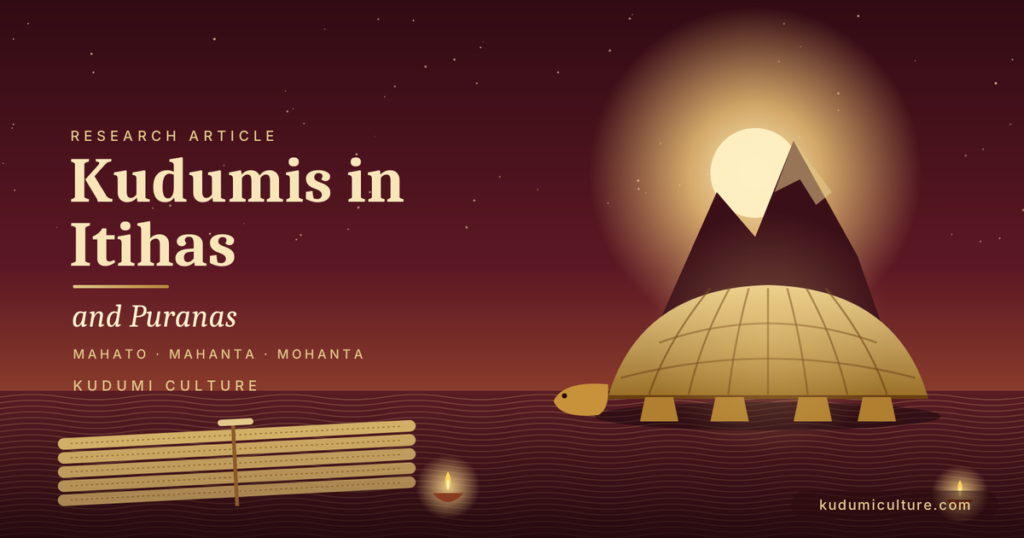
The first and most loved claim is about the name. Kurma is the tortoise form of Vishnu, who carries the Mandara mountain on his back when gods and demons churn the ocean of milk. The story is told in the Bhagavata Purana, where the Kurma form is placed in the sixth Manvantara, and in the Kurma Purana, which is named after the form itself [1]. Some community writers, and some writers on the Kurmi caste, connect the name Kurmi with this tortoise, and a few add links with Rama and with Indra, but the paper that records this is careful to call them claims of some authors and not established facts [9]. The reason it is only a claim is clear when one reads the texts as they are summarised. The Kurma story is about Vishnu, the mountain and the ocean, and nothing in the summaries reviewed says that it is about a farming people, a clan, or any group called Kurmi [1].
The scholars who study the name give other explanations. Writers on the Kurmi caste say that it is debated, with one view linking it to the Sanskrit word krishi (cultivation) and another to older regional roots, and they give no strong evidence for either [3]. A recent paper by a Kudmali-language scholar traces Kudmi and Kurmi to Kudmali words for earth or soil and for a tiller, and it mentions a rival explanation that is unkind and is not repeated here [8]. These meanings are all about the land, and that fits a community that is known everywhere as a farming people. It also fits the way the Kudumi of Chotanagpur describe their own villages, as founded by clearing forest and breaking the soil [9]. The honest result is that the tortoise story is a beautiful religious symbol that the community has taken into its identity, and that the word-link between Kurma and Kurmi is a pious reading, not a proved one. A Kudumi family can keep Kurma in its heart and still say, in a research setting, that the name probably comes from cultivation.
4. The Itihas: Rama’s Sons, the Mahabharata and the Tribes of the Forest
The second claim says that the Kudumi descend from Kusha and Lava, the twin sons of Rama and Sita. This is a very old story. In the Valmiki Ramayana, the twins grow up in the hermitage of the sage, learn the epic, and sing it before Rama, who then recognises them. A later poem like the Raghuvamsa of Kalidasa tells it in a different way, and other texts such as a Jain Ramayana and the Padma Purana add the story of the twins capturing Rama’s horse [2]. What is interesting is that Kusha and Lava have been claimed as ancestors by many groups. The Bedi and Sodhi clans of the Sikh gurus say they come from them, and a writer on the subject adds that many royal houses, cities and communities trace themselves to the twins, but he does not name the Kurmi or the Kudumi among them [2]. So the claim is part of a wide Indian habit: when a community rises in social status, it looks for a link with the sun-dynasty of Rama. The Kurmi of north India did exactly this in the Kshatriya movement of the late nineteenth and early twentieth centuries, and its caste association was founded for this purpose [3][10].
The Mahabharata gives the community less, and the sources reviewed show no mention of the Kudumi or Kurmi in it. It does speak of Kalinga, Utkala, Odra and the Vaitarani river, which are the regions near the Odisha Kudumi, and it speaks of forest peoples such as the Sabara, to whom the archer Jara, who shot Krishna, and Ekalavya are said to belong [4][5]. This is important for the tribe-or-caste question, because it shows that the epics already knew many forest and hill peoples as part of the world of the Kshatriyas, the Brahmins and the kings, and did not place them outside it. Still, none of this can be turned into a statement that the Kudumi are found in the epics. The Kudumi of Chotanagpur are known from colonial records, from gazettes and from community memory, and the oldest written notice of them that the sources reviewed can give is the colonial one, such as Risley’s description of 1891 [6][8]. Anyone who tells a family that the Mahabharata names the Kudumi should be asked for the book and the verse.
5. The Odisha View: Mahanta, Mohanta and the Land of Utkala
From Odisha, the question looks a little different. The Kudumi of this state live in Mayurbhanj, Kendujhar (Keonjhar), Sundargarh and Balasore, and one recent paper describes the Vaitarani among the rivers that bound their main homeland [8]. In Kendujhar and Sundargarh the family title is Mahanta, and in Mayurbhanj it is Mohanta, and one reference page lists “Kudumi Mohanta/Mahanta” as an alternative name of the community, alongside Mahato and Kudmi [7]. In the Chotanagpur side of the literature the title Mahato is described as the traditional village headman, who sat above a council of villages under officers called the Paraganaik and the Deshmandal [7]. It is a fair question whether Mahanta and Mohanta carry the same old memory of village leadership, but no source reviewed says so, and the article does not claim it. The Puranic and epic world that Odisha knows is that of Kalinga, Utkala and Odra, and the Vaitarani and the goddess Viraja, which the Mahabharata names, and of the Sabara hunters of the forest [4][5]. Neither the Kudumi nor any Mahanta or Mohanta family appears in these texts, as far as the summaries show.
The local histories of the two Odisha districts begin later and from a different footing. The Bhanja rulers held Mayurbhanj and Keonjhar from about the ninth century, first under the name Khijjinga Mandala, as copper-plate inscriptions show [12]. Keonjhar’s own tradition says that its state was founded in the twelfth century by Jyoti Bhanja, enthroned with the help of the local Bhuyan clans, and he is called the brother of Adi Bhanja of Mayurbhanj [11]. The pages reviewed do not mention the Kudumi at all, and they do not give Puranic references for the two districts [11][12]. This silence is itself a finding. It means that the history of the Odisha Kudumi, and of the Mahanta and Mohanta families, is still to be written from village records, temple and festival customs, family genealogies and the settlement papers of the old states. Religion gives another clue about identity. The community worships the village deity at the gramthan, and also Shiva as Budhababa, with Vishnu, Krishna, Durga, Kali and Manasa [7]. This blend of village and Puranic worship is exactly what one would expect of a farming people who live in a land that both the epics and the forest traditions claim.
6. Reading Myth and History Together
If the epics and Puranas do not name the Kudumi, why are the claims so strong? The answer lies in the social history of the last century and a half. Writers on the Kurmi caste say that Kurmis were generally ranked as a Shudra peasant caste, and that they long asserted Kshatriya status. Community leaders had genealogies written that traced the Kurmi to mythical Kshatriya lines, and an All-India Kurmi Kshatriya Mahasabha was formed for this purpose; one source dates it to 1894 and another places the Mahasabha at 1910, so the exact year should be checked [3][10]. This is what the sociologist M. N. Srinivas called Sanskritisation, the process by which a group takes up the rituals, myths and genealogies of the higher order to raise its place [3]. Seen this way, the Kurma story and the Kusha and Lava story are tools of that movement. The Chotanagpur Kudumi took part in this wave in the early twentieth century, and later a counter-current appeared that stressed a separate religion and a tribal past [6].
The colonial writers were divided in the same way. One recent paper reports that Dalton linked the Kudmi with the early Aryan colonists of Bengal, while Risley and Grierson described them as an aboriginal people of Dravidian stock [8]. The community’s own features, such as eighty-one totemic clans, non-Brahminical rites of birth, marriage and death, and nature worship, fit the second view better, and the Kshatriya genealogies fit the first [8]. Both can be true in one people. A farming community that has lived for centuries on the plateau, kept its own clans and festivals, and also lived beside Hindu kings, temples and Puranic storytellers, will naturally carry two memories. It remembers the forest and the village founders, and it remembers the great stories that the kings and priests told. The Puranic claim is therefore best treated as the second kind of memory. It is valuable for understanding how the community wished to be seen, and it should not be used as proof that the community was written about in ancient times.
7. Discussion and Conclusion
The main finding is simple. As far as the sources reviewed show, the Itihas and the Puranas do not name the Kudumi, the Kurmi of Chotanagpur, or the Mahanta and Mohanta families of Odisha. What the texts do give is a rich setting: the Kurma avatar, the twin sons of Rama, the kingdoms of Kalinga and Utkala, the Vaitarani river, and the forest peoples such as the Sabara. The Kudumi have drawn on this setting to tell their own story, in the same way that many other communities have done. A sensible position for a website like this one is to record these traditions with respect and label them clearly as community tradition, while keeping the evidence-based picture from the other articles, which rests on totemic clans, Kudmali language, colonial records and the long history of the plateau.
This study has limits. It read the epics and Puranas only through summaries, it could not open the Odisha Review paper on the Kurmi of Odisha [13], it found no source specific to the Mahanta of Kendujhar and Sundargarh or the Mohanta of Mayurbhanj, and several sources are brief papers or reference pages. Future work should read the original verses with a Sanskrit scholar, collect the oral genealogies that Odisha families keep, and study palm-leaf records, temple papers and old settlement records of Keonjhar, Sundargarh and Mayurbhanj. If any family holds a written genealogy or a local Purana that names the community, scanning it would be a real contribution.
References
Web pages were opened on 22 October 2026. Items marked (summary) were read through a page summary and not in full.
- Kurma avatar, turtle incarnation of Vishnu. The Gaudiya Treasures of Bengal, 2022. Cites Bhagavata Purana 8.5.9-10, 12.13.2 and Kurma Purana. (devotional site; summary)
- History of Luv-Kush, Sita’s three sons. Janata Weekly. Covers the Valmiki Ramayana, Raghuvamsa and later versions. (summary)
- Kurmi caste: history, distribution and political significance. Anantam IAS. No formal citations. (coaching-site article; summary)
- History of Odisha. Wikipedia. (summary)
- Sources of ancient history of Odisha. historyofodisha.in. (summary)
- Kudmi Mahato. Wikipedia. (summary; some claims tagged as needing citation)
- Kudumi Mahato. Bharatpedia. Lists titles, officers and worship. (summary)
- Mrinal Kanti Mahata. Revival of Kudmali language: identity politics of Kudmi community. IJCRT 14(2), February 2026.
- Nagendra Nath Mahto. Social, cultural and historical status of the Kurmi/Kudmi community in the state of Jharkhand. JETIR 12(5), 2025. (brief paper)
- Kurmi. Wikipedia. (summary; northern Kurmi)
- Keonjhar State. Wikipedia. (summary)
- Mayurbhanj district: history. Government of Odisha. (summary)
- The cultural life of Kurmi community in the district of …. Odisha Review, January 2018. Not read: the site blocked automated access. Please open it and check.