
Tusu is a month-long harvest festival kept every year from Aghan Sankranti in mid-December to Makar Sankranti in mid-January by the Kudumi and neighbouring communities of Jharkhand, western West Bengal and northern Odisha. It is led mostly by girls and women, and its main act of worship is the singing of Tusu songs. This article brings together twelve sources, which include four main research papers, three more academic papers, and five news and web reports from 2019 to 2024, to describe how the festival is performed, what its objects and songs mean, and how scholars explain its origin. We find that the ritual itself is closely tied to the paddy crop and to the idea of a daughter’s visit to her parents’ home, while the popular legends of a girl who drowned herself are many, mutually different and not supported by any document. We also find that the festival is not the same everywhere: in Bengal and Jharkhand the symbol is usually a pot or a decorated frame called a Choudol, while in Mayurbhanj, Odisha, newspapers describe a clay figure carried in procession. Recent writers worry about commercialisation and also ask if the legends of sacrifice are good for young women. We conclude that Tusu is best understood as a harvest and women’s festival first, and that its stories of origin are a later and varied layer.
Keywords: Tusu, Kudumi, Kudmi, Kurmi, harvest festival, folk songs, Chotanagpur, women, Makar Sankranti
1. Introduction
In the cold weeks between mid-December and the middle of January, when the paddy has been cut and the farmers finally get some rest, the Kudumi villages of eastern India start to sound different. Every evening, girls and women sit together near a small lamp and sing for a goddess called Tusu. This goes on for about thirty days, and then Tusu is carried to the river and given to the water. The festival is also known as Tusu Parab or Tusu Porob, and in Odisha it is closely mixed with the Makar festival.
The Kudumi, also written as Kudmi or Kurmi, are a settled farming community who live mainly in Jharkhand, in the Purulia, Bankura and Paschim Medinipur districts of West Bengal, and in Mayurbhanj, Keonjhar and Sundargarh of Odisha [1]. Their festivals follow the cycle of paddy cultivation and are fixed according to the movement of the sun, not the moon [1]. In this cycle Akhain Yatra opens the farming year, Rohin marks the sowing of seeds, Karam is celebrated with young seedlings, Bandna or Sohrai thanks the cattle and tools, and Nawa Khai marks the first eating of the new rice. Tusu comes at the end of this chain [1][2]. Mohanta lists Tusu, Bandna, Karam and Jitua as the four most important Kudumi festivals [1], while Kuiry treats Tusu as the year-ending festival [2].
This article has three aims. The first is to describe the ritual calendar of Tusu as it is reported in different regions. The second is to explain the meaning of its materials and songs. The third is to look at the different theories of origin, and at the new questions raised by recent writers, with simple language so that the general reader, students and the community itself can follow the discussion.
2. Sources and method
This is a desk-based review and not new fieldwork. We have used four main papers: Mohanta (2011) on the Kudumi of northern Odisha [1], Kuiry (2025) on culture and ecology [2], Sudipta Mahato and Panda (2023) on rituals and present-day practice [3], and Binapani Mahato (2025), which is based on a lecture and is about the Kurmi of Bengal [4]. To these we have added a gender-based reading of Tusu legends by Bhattacharji and Kuiry (2021) [5], a paper on Tusu songs by Deb (2019) [6], an ethnographic paper on Kudumi festivals in Mayurbhanj and Keonjhar by Rajashree Mohanta (2025) [7], and four news and web reports, namely Mishra in The Indian Tribal (2022) [8], two OrissaPOST reports of 2019 and 2020 [9][10], a photo story by Bhattacharyya (2024) [11], and an official Jharkhand government page [12]. News reports are useful for seeing how the festival is kept today, but they do not carry the same weight as peer-reviewed papers, and we say so wherever we rely on them. Some points were available only as a short summary on the web, for example the paper by Deb, and we have used only what was clearly stated.
3. Who is Tusu? Meaning of the name
The most important thing to know is that Tusu is closely tied to the paddy crop itself. During the last round of harvesting, every family leaves one clump of paddy standing in the field. The women worship this clump, and it is later brought home, often carried on the head as a mark of respect. In the field it is called Dhani Thakuran, on the head it is called Dini Thakuran, and once it is kept inside the house it is called Dimni Thakuran, and “Thakuran” means goddess [4]. A well-known saying in the Kurmi language says, “Je Dini sei Tusu Moni”, which means that the one who is Dini is none other than Tusu Moni [4]. The same clump is also called Dini Budhi, and people believe that when this ritual is done, Goddess Lakshmi, or Tusu, enters the house [2][3]. Kuiry therefore writes that Tusu is worshipped as Poush Lakshmi, the goddess of food, wealth and fertility [2]. Deb’s paper on Tusu songs also calls her “the goddess of crops” [6].
Not everyone agrees on who exactly the goddess is. In a report from Mayurbhanj, experts quoted by OrissaPOST were unsure which goddess the community worships, and some of them suggested Lakshmi or Gayatri, saying that Gayatri was also called “Supta Devi”, a name that may have slowly become Tusu [9]. This is a guess reported in a newspaper and not an established fact. Rajashree Mohanta describes her as the goddess of unmarried girls [7], and Bhattacharji and Kuiry say that Tusu is also imagined as a mother, a bride, a wife and a companion [5]. The official Jharkhand page says plainly that there is no documented history of the festival, though it has a rich body of lively folk songs [12].
The papers also do not agree on whether Tusu has a physical form. Mohanta writes that she is an idol made of mud and kept in the house [1], and Sudipta Mahato and Panda say she is made of mud and straw, or of a ball of cow dung and a ball of rice flour marked with three vermilion lines [3]. Binapani Mahato says clearly that Tusu has no human shape and no idol, and according to her the girls collect the grains that have fallen in the field, make rice powder from them, mix it with cow dung, and place it in an earthen pot with husk balls and some paddy on top, and this pot is worshipped as Tusu [4]. The Mayurbhanj reports describe a clay figure made by young girls [9]. Kuiry adds that the way of installing Tusu “varies in regions” [2]. It is quite possible that all of these are true, because every region and every family has its own way.
The origin of the word “Tusu” is also not settled, and scholars have given at least five explanations. The simplest one links it to tuso or tush, the husk of paddy, which is an important offering and is mixed with cow dung to make the Tusu form. This fits well because paddy is de-husked in the very weeks of the festival [1][2][4]. A second explanation says that Tusu is short for “Tusumoni”, since the word moni is added to many girls’ names in this region, like Raimoni, Birmoni and Sukurmoni [1]. Binapani Mahato supports this by saying that moni means a young girl in the Kurmi language, so Tusu Moni is a youthful goddess and not an old or pregnant woman [4]. Sukumar Sen suggested that the name may come from the Tisya star, which is linked with the vows of unmarried girls in Bangladesh [2]. Another view connects it with Toshal or Tushar, an ancient land or people, and one more view says it is worship of Makarbahini, the river goddess Ganga, because the festival falls on Makar Sankranti [1]. No single explanation can be called final, but the first two are closest to the daily life of the farmers.
4. The ritual calendar
Tusu begins on Aghan Sankranti, the last day of the Bengali month of Aghan, which falls in mid-December. On this day Tusu is installed in the house. In one common method, a clay plate called sara is coated with rice powder and white clay, a ball of cow dung is placed on it, and the ball is decorated with vermilion, marigold and akanda flowers [2]. Bhattacharji and Kuiry, and Sudipta Mahato and Panda, describe the worship in four stages: installation and invitation, care and nurturing, awakening, and finally immersion [3][5]. They also note that there is no fasting and no special mantra [5]. For the whole month of Poush, Tusu is treated as a guest of the family. Every day she is offered flowers, especially marigold, along with unboiled rice, jaggery, puffed rice, milk, ghee and water. An earthen lamp is lit at dusk and incense is burnt, and the lamp is lit again in the morning to wake her up. In the evening, the women gather and sing, and it is believed that Tusu listens to the songs before she goes to sleep [3]. The Bandu flower, a red flower from the Sal tree, is considered very important for the worship, and it is offered together with five kinds of vegetable flowers like brinjal and tomato [4]. Mishra adds that the unmarried girls take the lead, and that the home rituals continue until Makar Sankranti [8].
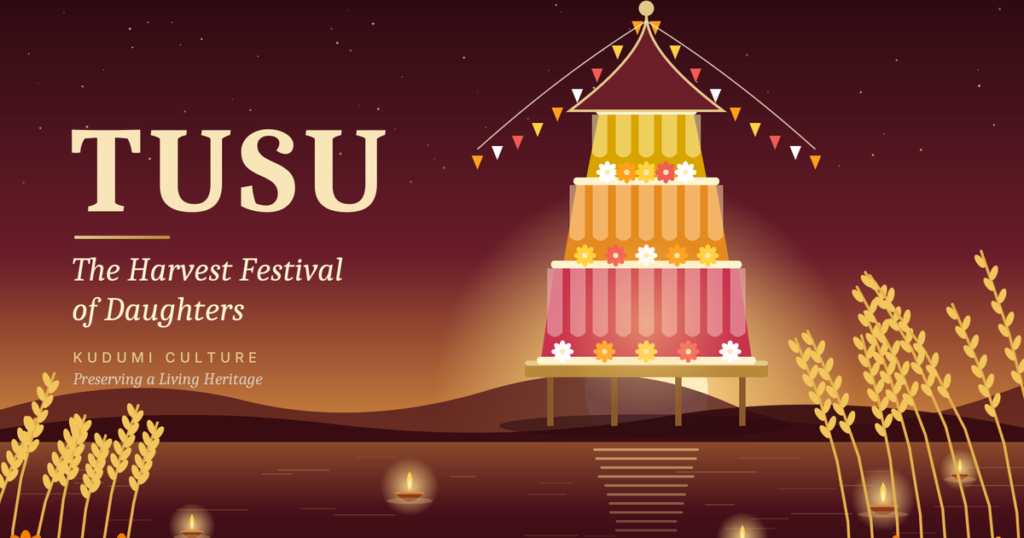
The last five days are the busiest. On the day called Aundi, rice is washed and soaked in water. On Chaundi, it is ground into flour. On Baundi, the women prepare pithas, which are rice cakes like gudpitha and undhi pitha, and the night of Baundi is a jagran, when everyone stays awake and sings Tusu songs till morning [3]. Mishra mentions other festival foods like maans peetha, which is a rice-flour roll stuffed with minced meat, lai (jaggery laddu) and tilkut, a sweet of sesame and jaggery [8]. Then comes Makar Sankranti, the final day, when Tusu is placed on a Choudol and taken to the river. A Choudol is a colourful frame made of bamboo sticks and coloured paper, and it has four holding points so that it can be carried and swung [2][4]. Special offerings, including eight kinds of grain, are made to the goddess, and the people gather on the river bank at a fair that Mohanta calls the Tusu Bhasani Mela, the fair of immersion [1][3]. Many well-known Tusu fairs are held every year on the banks of the Damodar, Kangsabati, Subarnarekha, Kharkai, Kanchi and Ajay rivers and their smaller branches [3]. The very next day is Akhan Yatra, the first of the month of Magh. Farmers consider it a lucky day to start the new season, so cow dung is spread on the fields and ploughing is started with a small ritual [3].
5. Meaning of the materials
Every material used in Tusu has a meaning that goes back to the farm and to fertility. Husk and cow dung are linked with the fertility of the land, and indeed the cow dung stored in a pit is spread on the fields as compost just after Makar [1]. Turmeric, marigold and brass jewellery, which the young girls wear, are taken by Mohanta as signs of fertility [1]. Binapani Mahato gives a few more meanings. She says the earthen pot of Tusu stands for the womb of a woman, and so it points to birth, rebirth and creation. The paper flowers on the Choudol stand for the five elements of nature, which are earth, water, fire, air and space. Tusu must be immersed only in a flowing river and never in a pond, because moving water is the “in-laws’ house” of Tusu and it also shows that life keeps moving. She also compares the thirty days of the festival with the monthly cycle of a woman [4]. These are the readings of individual scholars and not the words of every villager, but they show how deeply the festival joins the farm, the human body and nature in one picture. It should be noted that not every writer sees only a pond or a river as the end point: Bhattacharyya, writing from Purulia, Bankura and Birbhum, says that the girls immerse Tusu at nearby ponds or rivers, and that at dusk the immersion comes with a sad sound [11].
6. Songs as worship
In Tusu there is no priest and there is no fixed mantra. Kuiry notes that songs are the only way to call Tusu and to thank her [2], and Binapani Mahato goes a step further and says that the songs themselves are the real puja. According to her, the young working girls of the community, called karmaiti, keep singing until long after midnight [4]. She divides the songs into five kinds. The first kind sets up Tusu on Aghan Sankranti. The second kind shows Tusu as a young girl playing with her friends. The third kind describes feeding Tusu and decorating her with jewellery. The fourth kind takes her on a journey, which reminds us of a married daughter coming back to her father’s house. The fifth kind is sung in the voice of Tusu’s mother, who gets hurt when someone says her daughter is dark and defends her [4]. Bhattacharji and Kuiry add that the mood of the songs slowly changes from joy to sadness as the day of immersion comes near [5].
Kuiry has translated some couplets which show how simple and loving these songs are. In one of them the singers see Tusu playing under a kadam tree and say that her beauty is like the morning sun lighting the earth. In another, her friends tease a restless Tusu who keeps talking about water, and they say, “We know, your in-laws’ house is there.” A third song says, “We put oil, we put cotton”, and lights a lamp for Tusu. At the time of installation the women sing that they are setting up Tusu in a threshing yard full of golden paddy, and here the grain is compared to gold, which shows how much the farmers value a good harvest [2]. Many of these songs are made on the spot by the women, so they are also a place for their creativity. Bhattacharji and Kuiry confirm that new songs are composed every year to reflect the present social situation, and that they express the wishes, dreams, happiness and sorrow of women [5]. Kuiry says Tusu songs have sometimes been used as a voice of protest against social injustice [2], and Sudipta Mahato and Panda tell us that even today new songs are written on local problems and politics [3]. Debashree Deb, who studied Tusu as a folk song of Rarh Bengal, says that Tusu is sung throughout the month of Poush from Agrahayan Sankranti and that it keeps traces of old folk culture even as Indian folk culture has changed a lot [6]. We could read only the abstract of her paper, so we cannot say more about the tunes and the singers.
Kuiry also looks at Tusu through the idea of “ecogenderism”, which simply means the link between nature and women. In his view, women carry much of the care of the crop, the home and the festival, and the songs express a close bond between women and nature, where the pain of separation at the time of immersion comes with the hope of meeting again next year. He is careful to say that this is only one way of looking and that it may sound a little stereotypical [2].
7. Marriage, gender and community
The festival is closely linked with marriage. Mohanta records that Kudumi weddings are not held before Makar Sankranti, and that the search for a bride begins at Akhan Yatra. At the Tusu fair the unmarried girls sing and dance, and the boys get a chance to see a girl they may like before sending a proposal to her parents [1]. Bhattacharji and Kuiry also say that the fairs are places where Kudmi parents look for matches for their children [5]. Sudipta Mahato and Panda explain the mood of the month in a very human way: just as a mother waits for her married daughter to come home, the housewives wait for Tusu in the rich month of Poush, and just as a daughter’s wishes are fulfilled in her mother’s house, Tusu is offered many kinds of food [3].
The sources differ slightly on who takes part. Binapani Mahato says that the main participants are the young girls, with the older women helping them [4], while Sudipta Mahato and Panda say that unmarried girls worship Tusu and married women do not [3], and Kuiry simply speaks of Kudmi women [2]. Mishra also puts unmarried women at the centre [8]. Village-level fieldwork can settle this question. On the question of community, however, the sources are clear. Binapani Mahato says that Tusu started among the Kurmi [4], but today Mohanta finds that neighbouring tribes and castes have also adopted it, and it has become a festival of the whole region [1]. Kuiry names the Santhal, Munda, Kharia and Ho as participants [2], and Deb lists the Kora, Mahato, Lodha and Santal among the people who join, along with people of different religions [6]. Sadhan Mahato, quoted by Sudipta Mahato and Panda, says that Tusu is not only a religious festival and is kept by people of all castes and faiths, including Hindus, Muslims, Christians and Adivasis [3]. In the same spirit, the anthropologist Satya Narayan Munda, quoted by Mishra, calls Tusu a binding force between the cultures of Jharkhand and Bengal, and between tribal and sadan communities [8]. Raja Ram Mahto of the Kurmali Bhasha Parishad, also quoted by Mishra, says it is perhaps the only Jharkhand festival when everyone wears new clothes and houses are full of stored grain [8].
8. Theories of origin
Nobody knows for sure how Tusu began. Mohanta sorts the ideas into three groups: mythological, historical and anthropological [1]. The mythological view is not very popular. Singh points to the ancient texts, which speak of the Tushar or Tokhari people, and links the name Tusu with Toshal, an old land. If this is right, Tusu would be the festival of the people of Toshal and the tradition would be very old [1].
The historical explanation is the one most often told in villages and in the newspapers. In every version, a beautiful girl is chased by the soldiers of a powerful ruler, and to save her honour she jumps into a river on the day of Makar Sankranti. The women of the community then remember her every year through the festival. The details, however, change from place to place. In one story of the 18th century, soldiers of a Nawab of Bengal try to kidnap a beautiful Kudumi girl of Jharkhand. The Kudumis and Santals protest, the Nawab punishes the soldiers and sends the girl back, but the society does not accept her, and she ends her life in the river Damodar [1]. In another story she is Tushmuni, the daughter of Birbal, who is the son of Raja Ratan Singh of Chittor, and she is hidden in the house of Sitaram Mohanta near Parasnath hill, but she is found and jumps into the river [1]. A third story calls her the daughter of Birbal Singh, a Kurmi king of Kashi, who runs away to Pareshnath hill, stays with a Santal family and finally jumps into the river Kansawati [1]. In a fourth story she is Tusmin, the daughter of Amar Singh Rathor, who is again hidden in Sitaram Mohanta’s house and jumps into the Damodar [1]. Mohanta also quotes a story from Rairangpur about a village woman named Tusu who threw herself in the river to escape insult [1]. Three of these stories place the event in the time of Sultan Alauddin Khilji, who ruled from 1296 to 1316, and connect it with the tale of Queen Padmini of Chittor. The papers also remind us that Firoz Shah Tughlaq marched through Manbhum towards Khiching in Mayurbhanj in 1361, and some historians see this as a possible background [1][3].
Recent newspaper and web writing shows that the story keeps changing even today. OrissaPOST in 2019 told the story of a daughter of a Kudumi king who chose to end her life rather than submit to a Muslim ruler of Odisha [9], and in 2020 it told of a landlord’s only daughter who lived under Mughal rule, whose fiancé was killed by a ruler after her father refused his proposal [10]. Both reports say that no well-documented historical record exists [10]. Mishra, writing in The Indian Tribal, gives a very different version in which Tusu is a Kurmi woman who led the poor farmers against a landlord who raised taxes and penalties during a severe famine, and when the farmers lost, she drowned herself rather than surrender [8]. This version has no foreign ruler in it, and it makes the festival a memory of a revolt over land and tax. It is a good example of how a community can retell the same event according to its own concerns.
It is important to read all these stories with care. They are folk tales. They give different names to the father, different places for the event and different villains, and they put together people who lived in different centuries. The papers themselves say that the origin is found only in “myths, folk-tales and folk-songs” and no document proves any one version [1]. So it is better to see them as the memory of a community about a young girl who protected her honour, and not as proved history. As we saw, the festival itself is kept by people of all faiths, and its songs are about daughters, crops and rivers.
The anthropological explanations look at the land and at the life of the people. Mohanta notes that Tusu is made of husk and cow dung, which are linked with the fertility of the soil, that the girls wear turmeric and marigold, and that the search for brides begins at Tusu time, and so he concludes that Tusu is “somehow related to the fertility cult” [1]. Banchanidhi Das records another tradition in which a young woman called Tusumini united the local Horo tribes and their allies against outsiders, called dikus, in the river basins of the Subarnarekha, Mayurakshi and Kansabati, and she was wounded and died in the fight [1]. P. K. Singh gave a third idea, that Tusu is a remnant of a very ancient time when young men and women of a group met freely. This is an old and speculative way of thinking, which many scholars today treat with caution, and we mention it only because it appears in the literature [1]. Bhattacharji and Kuiry make a more careful argument. They suggest that Tusu began as a fertility or harvest deity of tribal communities such as the Santhal, Munda, Kharia and Ho, and that it was slowly taken up by the Hindu Kudmi farming community, which moved from tribal status to the OBC category [5].
The agrarian reading, which is supported by the two most recent main papers, is perhaps the simplest. They say that everything inside the ritual points to paddy: Tusu is equal to Dini, the last sheaf, the husk, the threshing yard, the time right after the harvest, and the songs about golden grain [2][4]. Mohanta also reaches near this point when he says that paddy is cut in October and November, then threshed and de-husked in December and January, and Tusu comes exactly when the husk, tuso, is in everyone’s mind [1]. These explanations do not need to fight each other. A harvest ritual may have been the beginning, and over the years the stories of a brave girl may have joined it.
Bhattacharji and Kuiry also ask a hard question about the legends. After studying fourteen folk tales, they find that the death of a woman, often by suicide or sacrifice, is the first condition for her worship as a goddess. They say that over time the stories were fitted into Hindu and Rajput ideas, into the ideal of the sati, and into patriarchal ideas of honour and purity, and they fear that such stories may teach young women to accept self-sacrifice as normal [5]. This is a serious argument and it deserves to be discussed in the community. In our own reading, the ritual and the songs described in the papers speak mostly of care, play and longing, and they do not praise death.
9. Regional variations
The same festival looks a little different in each region. In the Bengal districts of Purulia, Bankura and Birbhum, Bhattacharyya describes it as “mainly the festival of crops”, with girls decorating the Choudol, immersing the Tusu in nearby ponds or rivers, and large fairs [11]. Mishra says that big fairs are held at immersion ghats especially in the Panchpargana area, where the Choudols are made in competition by villages, puja committees and clubs, the best ones are given awards, and cockfights called baudi attract large crowds [8]. In Jharkhand, the state government page says that the festival is mostly seen in the belt between Bundu, Tamar and Raidih, where girls decorate a wooden or bamboo frame with coloured paper and give it to a nearby hill river [12], and Mishra notes that a Tusu Mela has been held at Morhabadi ground in Ranchi since the state was formed, though it stopped for two years because of the pandemic. He also says that the festival is known in rural Odisha and among tea garden workers in Assam [8].
In Mayurbhanj, the Odisha reports give a more detailed local picture. OrissaPOST says that the young girls make a clay figure of the goddess, the community carries it on their shoulders in a colourful procession through the village, and it is immersed in a river in the evening [9]. In 2020 the same paper said that Tusu Parab is the biggest annual celebration of the Kudumi of Mayurbhanj, that the Kudumi worship Tusu Devi on this day and not the Sun god, that on Makar Baundi, the day before, unmarried girls dress up and sing in groups, that the idols are immersed on Makar Chaundi, which is the morning of Sankranti, and that celebrations continue on Makar Dhaundi with a fair, cultural programmes, sports and cockfights [10]. Rajashree Mohanta, who did fieldwork in Mayurbhanj and Keonjhar, describes it as the Makar festival of Tusu Devi, the goddess of unmarried girls, which goes on from three to seven days, with songs and dances, the collecting of firewood, the making of pithas, a bath in a pond, a procession with the idol made by youth, immersion, and a feast [7]. It is important to note that the Odisha reports speak of a Makar festival of a few days, while the Bengal and Jharkhand sources speak of a month of nightly songs. This may be a real difference in practice, or it may be that the newspapers describe only the final days. More careful fieldwork is needed to know.
10. Tusu today
Today Tusu faces some new problems. Sudipta Mahato and Panda say that modern life, city growth and technology are making the old festivals less important, and that folk festivals are slowly moving into the villages. They are also worried that companies and organisations now arrange folk festivals, and that city visitors come to enjoy the singing, dancing and the party without knowing what Tusu really means [3]. Rajashree Mohanta also notes, in a wider discussion of Kudumi festivals, that many traditions are fading and that local customs are at risk [7]. Even so, the tradition is alive. New songs are made in the old style, and they speak about old stories as well as present politics and local issues, and the authors believe that the new tunes will slowly mix with the old custom [3]. Kuiry’s photographs from Patjhalda in 2022 and from Uhatu in 2021 show families still installing the Dini Budhi and carrying the Choudol to the water [2]. Public fairs, such as the Tusu Mela in Ranchi and the competitions for the best Choudol, show that the festival has also become a stage for the community’s pride and identity [8]. This is a happy sign, but it also brings the danger that the show becomes more important than the meaning.
11. Discussion
When we put all the sources together, three things stand out. First, the most stable part of Tusu is the ritual, and not the legend. The last sheaf of paddy, the husk and the cow dung, the lamp and the daily songs, the Choudol and the flowing river appear again and again in papers from different decades and different states, and they all point to a woman-centred harvest festival. The legends, on the other hand, are many and they contradict each other, and even the identity of the goddess is unclear in the newspaper reports. Second, Tusu is a shared festival. The papers speak of Kurmi, Santhal, Munda, Kharia, Ho, Kora, Lodha and others, and of Hindus, Muslims and Christians, and the anthropologist quoted by Mishra calls it a bridge between tribal and sadan communities. This is important for the Kudumi, whose place between tribe and caste is a matter of public debate, and Tusu shows how much of their culture is held in common with their neighbours. Third, there is a quiet debate about what the festival teaches. The older papers mostly praise the legend of the girl who saved her honour, while Bhattacharji and Kuiry ask if such a story is a good model for young women. Readers will have their own opinion, but any honest account must put the question on the table.
12. Limitations
This article depends on published sources and on what is available online, and it has not used fieldwork or interviews. Some of the papers are summaries of lectures or short abstracts. Newspaper reports vary in quality and cannot be treated as final authority. The four main papers differ on small points, which we have shown in the text: whether Tusu has an idol, who exactly worships, the Kudmi’s tribal status year (Mohanta says 1931 and Kuiry says 1921), and the dates of the festival (one paper says mid-November to mid-December in its introduction but uses the Aghan to Poush dates later, which we take as a slip). There are also many Bengali and Hindi sources, including books on Kurmali folk culture and Tusu songs, that we could not read, and a full study should include them.
13. Conclusion
Tusu is a festival of the harvest, of daughters and of song. It closes the Kudumi farming year with a month in which women and girls look after a goddess made from the last grain of the field, sing to her every evening, and finally send her to the river like a married daughter. Scholars explain its origin in different ways, but the strongest evidence lies in its own materials and songs, which tie it to paddy and to the life of women. The stories of a girl who gave her life are widely told and deserve respect as folk memory, but they are not proved history and they change from place to place. As the festival moves into cities and onto stage, the work for the community is to record the songs, the recipes and the family ways of keeping Tusu before the older generation is gone. If your family keeps Tusu in a different way, or if you know a song, please write to us and help us record it.
References
- Mohanta, Basanta K. (2011). “Tusu Festival of the Kudumis of Northern Orissa: Origin and Causes.” Journal of Sociology and Social Anthropology, 2(1): 23-29.
- Kuiry, Hare Krishna (2025). “The Tusu Festival and Kudmi Identity: Ecogender Dimensions of Culture and Agriculture in Bordering Regions of Jharkhand and West Bengal.” Creative Flight, 6(4), October 2025: 214-225.
- Mahato, Sudipta and Panda, Ujjwal Kumar (2023). “Tusu Festival – A Part of Folk Culture: A Review.” International Journal of Multidisciplinary Educational Research, 12(1)(2), January 2023: 47-49.
- Mahato, Binapani (2025). “Harvest, Ritual, and Femininity: The Tusu Festival among the Kurmi of Bengal.” Sahitya, 13, December 2025: 456-467. Based on a lecture; transcription by Abhik Sarkar.
- Bhattacharji, Shreya and Kuiry, Hare Krishna (2021). “Death to Deification: Reading the Many Tales of Goddess Tusu.” Journal of the Department of English, Vidyasagar University, vol. 14: 294-314. Available at ir.vidyasagar.ac.in
- Deb, Debashree (2019). “An Analytical Study of Tusu: A Traditional Folk Song.” Sangeet Galaxy, 8, January 2019: 6-11. Abstract online
- Mohanta, Rajashree (2025). Paper on Kudumi festivals and fairs of Mayurbhanj and Keonjhar. International Journal of Novel Research and Development, 10(5), May 2025. PDF
- Mishra, Sudhir Kumar (13 January 2022). “Tusu: female fortitude.” The Indian Tribal. Link
- OrissaPOST (17 January 2019). “Tribal dance, music mark Tusu Parav.” Link
- OrissaPOST (15 January 2020). “Makar Sankranti is celebrated as ‘Tusu Parab’ in this place.” Link
- Bhattacharyya, Saktipada (17 January 2024). Photo story on Tusu festival in Bengal. The Space Ink. Link
- Government of Jharkhand, Chief Minister’s Office. “Tusu Parab or Makar.” Link